The History of Mechanical Keyboards: From Typewriters to Endgame
By Jota Martínez • • Blog
The mechanical keyboard you type on today is the direct descendant of a machine invented in 1868. Every decision made along the way — which key size, which switch mechanism, which layout — carries the accumulated weight of 150 years of engineering, commerce, and coincidence.
This is the full story: how keyboards evolved from mechanical typewriters to IBM's legendary Model M, through a 15-year dark age of membrane dominance, and into the modern enthusiast era where a single keyboard can cost more than a laptop.
Quick Answer: The first mechanical keyboard was invented in 1868 when Christopher Latham Sholes patented the Sholes & Glidden Type-Writer. IBM introduced the first computer-specific mechanical keyboard (Model F) in 1981, and Cherry released its iconic MX switch series in 1983 — the foundation of every modern mechanical keyboard.
Key Dates at a Glance
| Year | Event |
|---|---|
| 1868 | Sholes & Glidden Type-Writer patented — QWERTY layout born |
| 1873 | Remington begins commercial typewriter production |
| 1961 | IBM Selectric typewriter establishes IBM's keyboard DNA |
| 1981 | IBM Model F released with PC XT — capacitive buckling spring |
| 1983 | Cherry introduces MX switch series in Germany |
| 1984 | IBM Model M released — the most iconic keyboard ever made |
| 1991 | Lexmark spins off from IBM, takes keyboard production |
| 1994–2007 | Membrane dark age — mechanical keyboards disappear from consumer market |
| 1996 | Unicomp acquires Model M tooling, still makes buckling spring keyboards |
| 2007 | Das Keyboard relaunches the enthusiast market |
| 2008 | GeekHack forum founded — enthusiast community forms |
| 2013 | QMK firmware open-sourced — custom keyboard programming democratized |
| 2016 | Hot-swap PCBs become mainstream — no-solder switch changes |
| 2019 | Keychron launches — wireless mechanical keyboards go mainstream |
| 2020–present | Market explodes: gasket mounts, custom builds, $500+ boards common |
The Origin: Typewriters (1868–1960)
The ancestor of the keyboard is the typewriter. The first commercially successful model was the Sholes & Glidden Type-Writer, patented in 1868 and sold by Remington starting in 1873. It introduced the QWERTY layout — a letter arrangement designed around the mechanical constraints of typewriter typebars, not around typing speed or ergonomics.
Typewriter keys were mechanical in every sense: pressing a key caused a physical lever (typebar) to strike a ribbon and imprint ink on paper. Each key had a definitive, tactile endpoint. Typists from the era describe a clear satisfaction in the mechanism — the kind of feedback that modern keyboard enthusiasts are still chasing.
The QWERTY layout survived the transition from typewriters to computers almost entirely intact. Alternative layouts like Dvorak (1932) and Colemak (2006) have never achieved significant adoption despite research suggesting they can be more efficient.
IBM and the Birth of the Computer Keyboard (1961–1981)
In 1961, IBM released the Selectric typewriter — a revolutionary machine that replaced individual typebars with a single rotating "typeball." It was not a keyboard, but it established IBM's design language for key feel and layout that would define computer keyboards for decades.
Early computer terminals in the 1960s and 1970s used full mechanical key mechanisms because it was the only reliable technology available. The IBM 3270 (1971) and similar terminals used individual switches per key, giving typists consistent, tactile feedback with every press.
In 1981, IBM released the Model F keyboard alongside the IBM PC XT. The Model F used a capacitive buckling spring mechanism — a design considered by many keyboard historians to be the peak of switch engineering. Each spring buckled under pressure, creating an audible click and a tactile snap simultaneously. Model F keyboards are still in active daily use today and routinely sell for $200+ on the used market.
The IBM Model M: The Benchmark (1984)
In 1984, IBM introduced the Model M. It used a slightly simplified version of the buckling spring mechanism — a membrane beneath the spring rather than the Model F's capacitive design — which allowed for mass production at a lower cost without dramatically compromising feel.
The Model M became the standard keyboard for IBM PCs and compatibles throughout the late 1980s and early 1990s. Tens of millions were manufactured. Its characteristics — heavy steel backplate, 2.2 kg total weight, loud click, strong tactile response — became the template for what "a good keyboard" meant for a generation of typists.
Model M production passed to Lexmark (a former IBM division) in 1991, then to Unicomp in 1996. Unicomp still manufactures new buckling spring keyboards today in Lexington, Kentucky, using original tooling.
Cherry MX: The Switch That Defined an Era (1983)
While IBM was building the Model M, a German company named ZF Electronics (operating as Cherry Corporation) was developing a different approach to switch design. In 1983–1984, Cherry introduced the MX series: modular mechanical switches using a stem-and-housing architecture that became the industry standard for decades.
The Cherry MX design was elegant in its simplicity: a color-coded stem determined the switch type (Red = linear, Brown = tactile, Blue = clicky), and the housing was standardized so keycaps from any manufacturer would fit any MX switch. This modularity — which seemed unremarkable at the time — would later make Cherry MX the foundation of the enthusiast keyboard market.
Cherry MX switches were used in professional and industrial keyboards throughout the 1980s and 1990s. They remained a niche professional product through the membrane era, and became the catalyst for the enthusiast revival in the 2000s.
The Membrane Dark Age (1994–2007)
By the mid-1990s, the personal computer had gone mainstream. Cost pressure became the dominant force in keyboard design. Membrane keyboards — which replaced individual switches with a continuous sheet of plastic and conductive traces — could be manufactured for a fraction of the cost of mechanical keyboards. By 2000, virtually all consumer keyboards sold were membrane.
The quality difference was dramatic. Membrane keyboards offered mushy, imprecise key feel with no tactile feedback at the actuation point. Bottom-out was the only signal that a key had been pressed. Noise was reduced, but at the expense of everything that made typing feel deliberate.
For approximately 13 years (roughly 1994–2007), high-quality mechanical keyboards were nearly impossible to buy new. Professional users kept their Model M keyboards alive through decades of use. A small number of boutique manufacturers (Filco, Leopold, HHKB) continued building mechanical keyboards for niche professional markets in Japan and Europe.
The Enthusiast Revival (2007–2015)
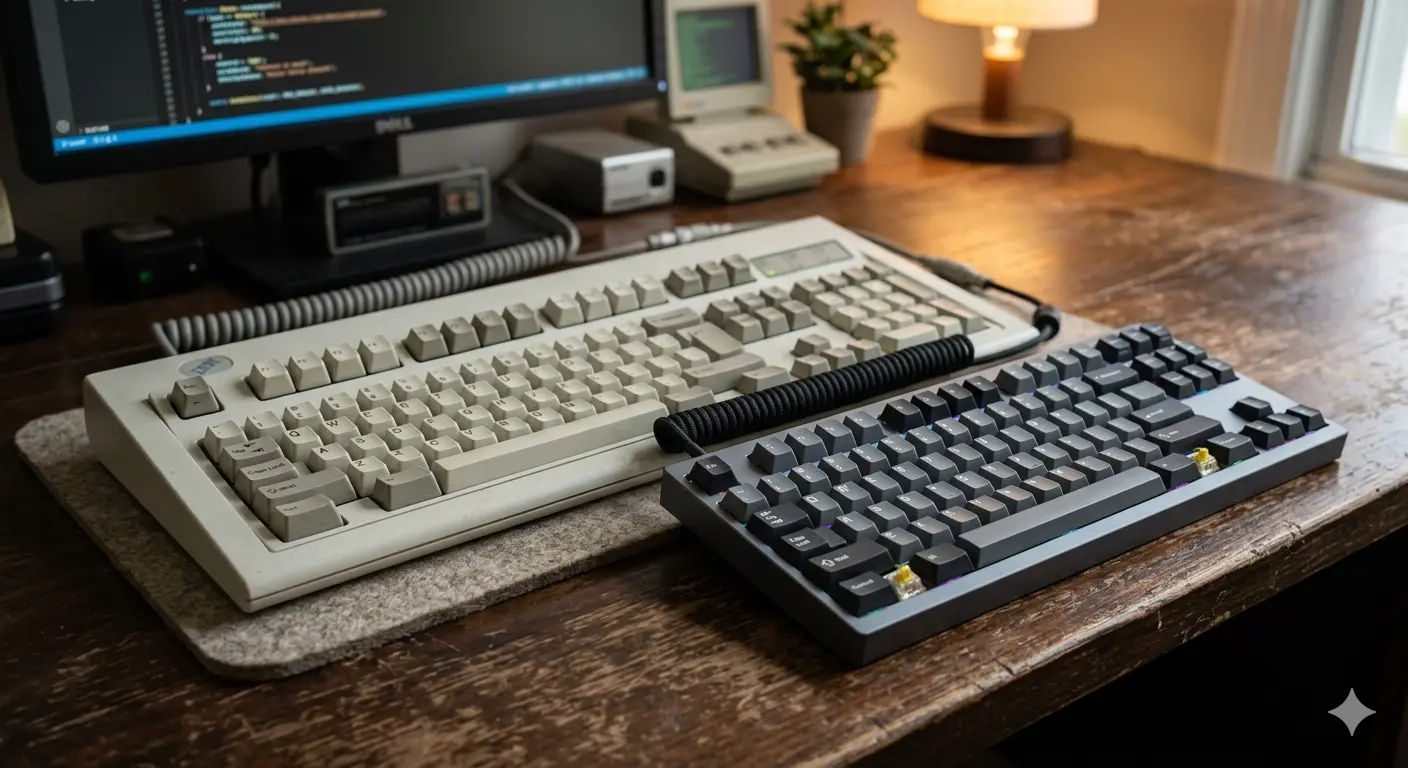
Contrasting vintage IBM keyboard and modern custom keyboard
The modern mechanical keyboard renaissance has a clear starting point: 2007, when Das Keyboard introduced the first "enthusiast" mechanical keyboard marketed specifically to gamers and power typists. It used Cherry MX switches and was sold in a deliberately provocative blank (unlabeled) configuration that sent a strong message about its target audience.
Online communities formed rapidly around this new market. GeekHack (2008) became the central forum for keyboard enthusiasts, followed by Reddit's r/MechanicalKeyboards (2012). These communities created the vocabulary still in use today: endgame, thock, clack, GMK, SA profile, group buy.
Between 2008 and 2014, the market expanded rapidly. Filco, Ducky, Leopold, WASD, Vortex, and Cooler Master all entered with quality products. Asian manufacturers (particularly from South Korea and China) began producing custom parts: artisan keycaps, custom cases, aftermarket switches. The hobby took shape.
The Modern Era (2015–Present)
The period from 2015 to the present is characterized by the explosion of the custom keyboard market and the mainstreaming of the hobby. Platforms like Massdrop (now Drop), KBDfans, and NovelKeys made custom keyboard components accessible to a global audience. Group buys — pre-order campaigns for custom keycap sets and keyboard kits — became the primary distribution model for premium products.
Key developments of the modern era include: QMK open-source firmware (2013, programmable to any key layout), hot-swap PCBs (2016 onwards, allow switch changes without soldering), gasket mounting (decouples the typing surface from the case for a more flexible, "bouncy" feel), wireless mechanical keyboards (Keychron popularized this from 2019), and the rise of south Korean custom keyboard culture.
Today, the mechanical keyboard market spans $30 budget boards and $700+ custom builds. The community includes millions of participants across dozens of countries. What began as a preference among IBM typists who refused to give up their Model Ms has become one of the fastest-growing hardware niches in consumer electronics.
When Did Mechanical Keyboards Become Popular?
Mechanical keyboards have existed in some form since 1868, when the first typewriter was patented. They became mass-produced products in 1873 when Remington began commercial typewriter manufacturing. However, their popularity as computer input devices truly began in 1981, when IBM shipped the Model F with the original IBM PC — establishing mechanical switches as the standard for professional computing.
After a long decline during the membrane era of the mid-1990s through the 2000s, mechanical keyboards experienced a dramatic enthusiast revival starting in 2007. Das Keyboard's launch of a deliberately blank Cherry MX board reignited interest among power typists and gamers. Communities like GeekHack (2008) and Reddit's r/MechanicalKeyboards (2012) turned a niche preference into a global hobby.
The market has grown significantly since then. By the early 2020s, the global mechanical keyboard market was valued at over $2 billion and continues to expand annually. Mainstream brands like Keychron, Royal Kludge, and Epomaker have made mechanical keyboards accessible at every price point, while the custom keyboard segment has created a thriving ecosystem of artisan keycaps, boutique switches, and group-buy kits.
First Mechanical Keyboard vs. First Computer Keyboard
The first mechanical keyboard and the first computer keyboard are not the same thing. The earliest known mechanical keyboard is Henry Mill's 1714 typewriter patent — a device with individual mechanical keys that physically struck paper. The first commercially successful version was Christopher Latham Sholes' 1868 typewriter, which introduced the QWERTY layout still used today. These were mechanical keyboards in the purest sense: every keypress engaged a physical mechanism.
The first computer keyboard arrived much later. IBM's 1981 Model F was the first mass-produced mechanical keyboard designed specifically for a personal computer. It used capacitive buckling spring switches — a far more sophisticated mechanism than typewriter levers, but driven by the same principle: individual mechanical switches under every key. Earlier computer terminals from the 1960s and 1970s also used mechanical switches, but the Model F marked the moment mechanical keyboards entered the consumer market.
The modern mechanical keyboard era truly began in 1983, when Cherry Corporation introduced the MX switch series. Cherry MX switches standardized the design with a modular stem-and-housing architecture, color-coded switch types, and universal keycap compatibility. This is the technology that defines mechanical keyboards today — and the reason the term "mechanical keyboard" almost always refers to Cherry MX or MX-compatible switches.
Frequently Asked Questions
Want to understand what makes modern switches special? ? How mechanical switches work — full explainer
Interested in the most iconic keyboard ever built? ? The IBM Model M: why it's still legendary
Best Mechanical Keyboards 2026Related Articles
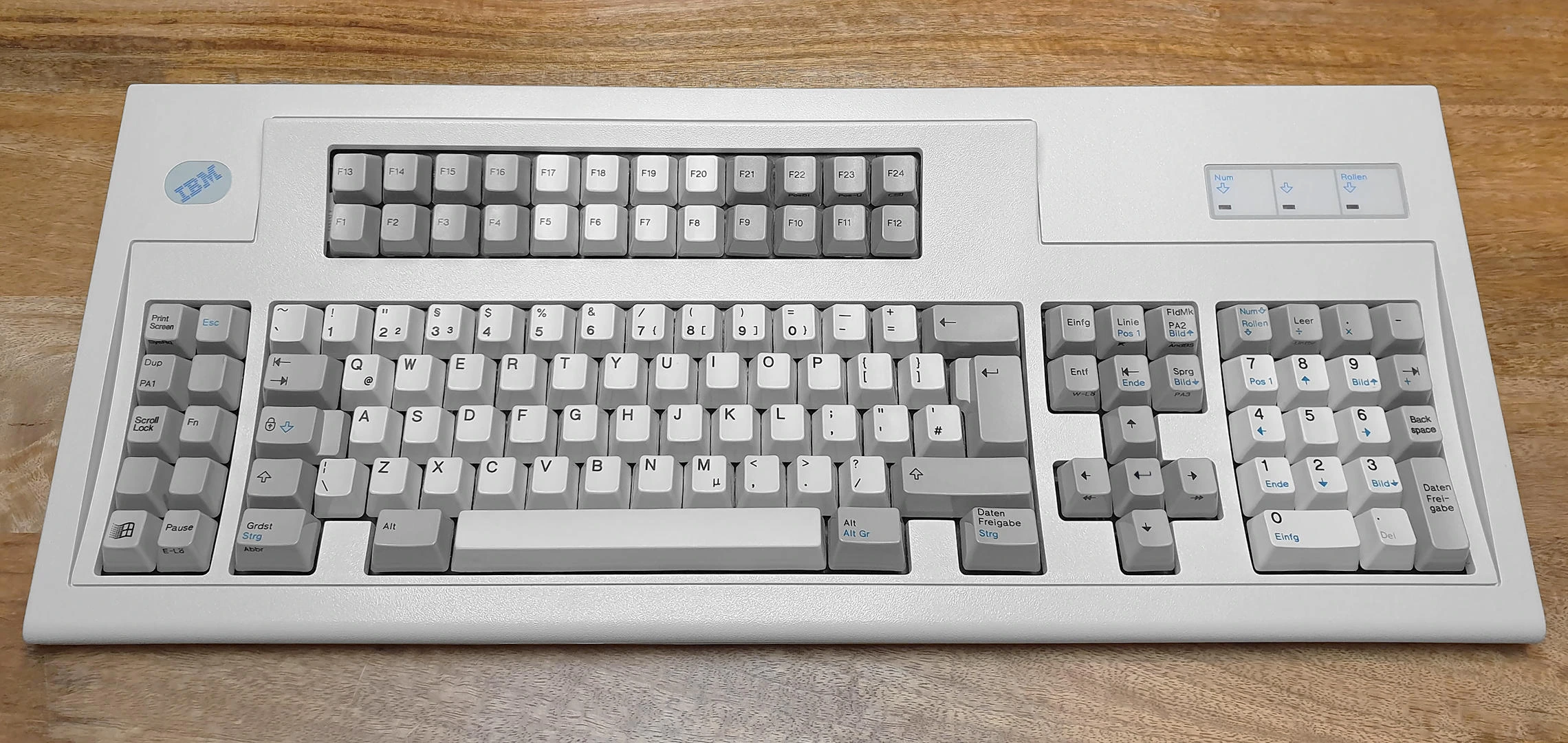
The IBM Model M: Why This 40-Year-Old Keyboard Is Still Legendary
The complete story of the IBM Model M: buckling spring switches, 2.2kg steel backplate, 40 years of daily use, and why enthusiasts still pay $200+ to own one.

The Origin of QWERTY Layout — And Whether Dvorak Is Actually Better
The myth that QWERTY was designed to slow typists is false. Learn the real history of QWERTY, what Dvorak actually promises, and what modern science says.